

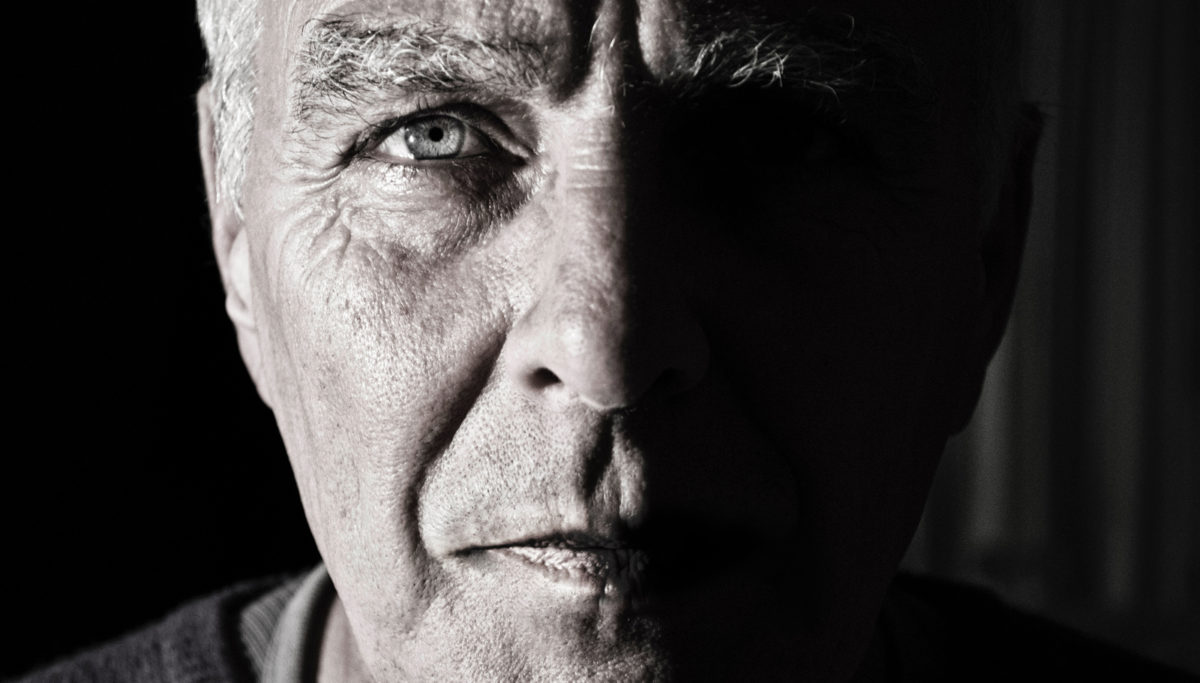
The face is the primary stage where our feelings are performed. While we focus heavily on the words we choose, our facial muscles often tell the “real” story before we even finish a sentence. In Unmasking the Face, researchers Paul Ekman and William V. Friesen expanded on Charles Darwin’s theories to prove that facial expressions are transcultural—a “biological blueprint” shared by all humans.
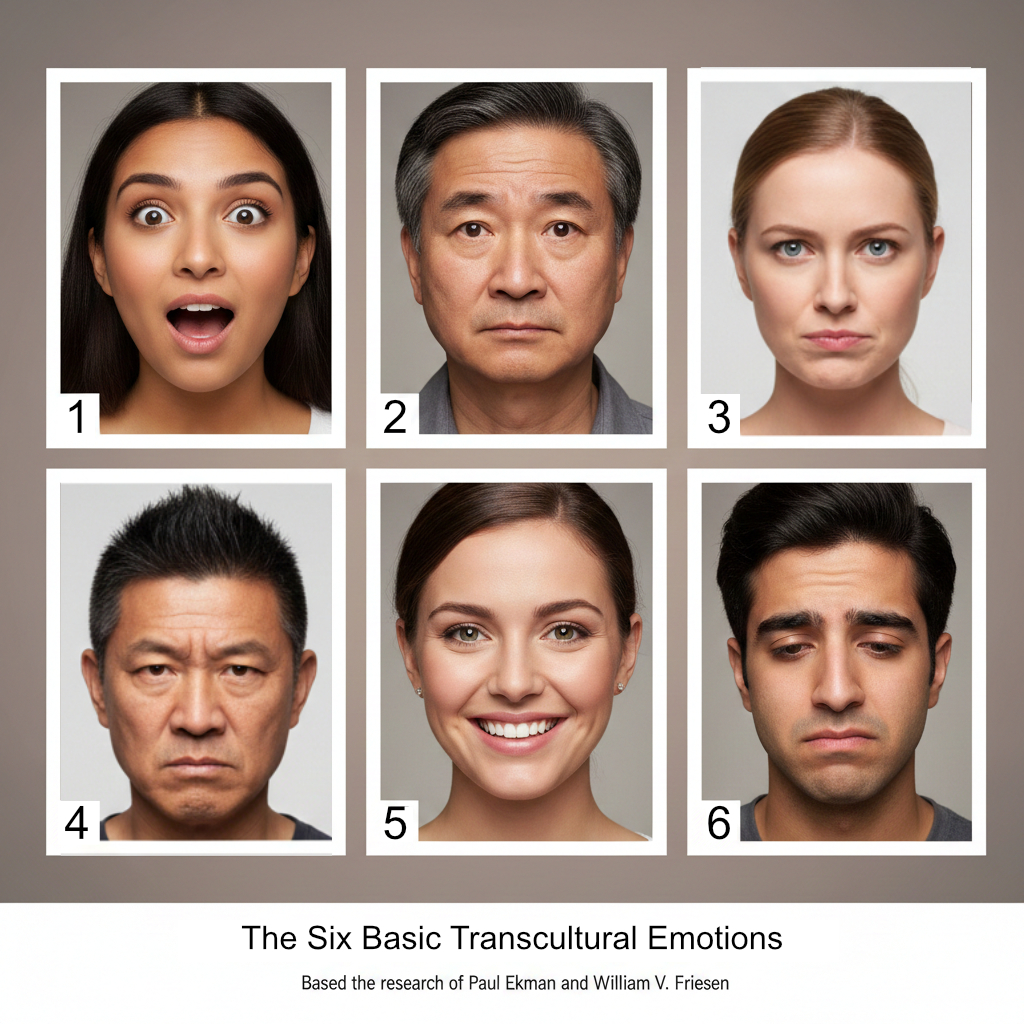
The Six Universal Emotions
Whether in Canada or Japan, these six emotions look the same. In a marriage, these often flash by in milliseconds as “micro-expressions.” If you aren’t looking, you’ll miss the true emotional state of your partner.
-
Surprise: Often combined with fear or happiness.
-
Fear: Look for tension in the eyes and brow.
-
Disgust: Often shown by a wrinkled nose or raised upper lip.
-
Anger: Characterized by knitted brows and tightened lips.
-
Happiness: Marked by the “Duchenne” crinkle around the eyes (genuine joy).
-
Sadness: Look for a slight drooping of the upper eyelids and a downturned mouth.
The Three “Hot Zones” for Decoding
To get an accurate reading, you must observe all three facial areas in conjunction. A “dropped jaw” might mean surprise, but if the eyes are also narrowed, it might actually be shock mixed with anger.
-
The Brow: The “warning light.” Arched brows signify surprise; lowered, knitted brows signify a brewing conflict or deep concentration.
-
The Eyes: The “connection point.” Widened eyes signal high arousal (fear/surprise), while “smiling eyes” (crinkling at the corners) indicate true safety and warmth.
-
The Lower Face: The “action center.” A tightened mouth or bared teeth can indicate a defensive posture, even if the words being spoken are polite.
Why Self-Awareness is Your Secret Weapon
Ekman and Friesen noted a striking irony: “We know less about our feelings than we do about our teeth, our car, or our neighbor’s escapades.” In a marriage, we often react to our partner’s face without realizing what our face is doing. If you approach your spouse to talk about a problem with your “anger” muscles already engaged (knitted brow, tight jaw), they will become defensive before you even open your mouth.
Mirror Tip: Practice these expressions in a mirror. Research shows that making the facial expression can actually trigger the emotion in your body. If you “put on” a smile, your brain begins to move toward a happier state.
Navigating the “Mask” (Display Rules)
While the biology of a smile is universal, culture and upbringing dictate when we show it. Some people are raised in “masking” cultures where showing sadness or anger is seen as a weakness. In marriage, you may need to help your partner “unmask” by creating a safe environment where their face doesn’t have to be a shield.
Marriage Mirror Exercise: The “Silent Minute”
Tonight, try this: Sit across from your partner. For 60 seconds, don’t speak. Just look at each other’s faces.
-
What do you see in their eyes?
-
Is there tension in their brow?
-
What is it like to be “looked at” by your partner?
The “Mirror Check” for Your Own Face
Before you approach your spouse with a concern, check your own “Face Blueprint”:
-
Relax the Brow: Don’t start a talk with a “combat brow.”
-
Unclench the Jaw: Tension here signals you are ready for a fight, not a conversation.
-
Soften the Eyes: Connection happens when the eyes are open and inviting, not narrowed and accusing.






very nice